Gaming soundbar vs gaming headset: what's the right audio solution for you?

If you're looking to upgrade your gaming audio, you may be wondering whether to go with a gaming soundbar or a gaming headset. Both routes have their own perks, you just need to decide which path's benefits best align with the way you play. Here's a rundown of what makes both soundbars and headsets great choices for gaming battlestations.
Key points: Both routes can deliver excellent audio, but they’ll get you there in different ways. Here's how they break down:
- Room-filling, shared-space audio: a quality soundbar gets you room-filling audio. The ROG Gjallar Gaming Soundbar is a prime example, with its full-range drivers, angled up-firing speakers, and dedicated wireless subwoofer.
- Pristine audio for one: ROG gaming headsets like the Kithara, Delta II, and Pelta give you privacy, while also sparing those around you from unwanted noise.
- All-in-one desk hub: gaming soundbars such as the Gjallar can serve a variety of devices at once. The Gjallar has an integrated USB hub, unified control panel, and support for USB-C, HDMI 2.1 with eARC, optical audio, 3.5mm, and Bluetooth 5.3.
- Widest range of tailored fits: a variety of ROG headsets exist to suit different needs, spanning the open-back planar magnetic Kithara to tri-mode wireless headsets such as the Delta II and ultralight Pelta.
Gaming soundbars can fill the room with sound

If you want your entire battlestation pulsing with sound, a gaming soundbar is hard to beat. Take the ROG Gjallar Gaming Soundbar: because it's engineered with dedicated full-range drivers, high-fidelity tweeters, and angled up-firing speakers, it creates a broad, detailed soundstage that fills the space around you instead of just the space between your ears. Pair that with Dolby Atmos support, and you get immersive, three-dimensional spatial audio. So if you’re playing a standard first-person shooter, you’ll hear the roar of aircraft overhead and feel the oomph of explosions while details like dialogue and footsteps stay clear.
A soundbar also brings bass into the equation in a way headsets can't. The Gjallar pairs with a dedicated 6.5-inch, 65-watt wireless subwoofer connected over a low-latency 5 GHz link, so explosions pack a serious sonic punch and engines rumble with gusto. This boosted bass makes a big difference in bombastic games like Battlefield 6 as well as racing games such as Forza Horizon 6. If you want your AAA blockbusters, larger-than-life movies, and bopping music to hit with real physical presence, that's a job for a soundbar and subwoofer.
The large-scale audio experience a good soundbar provides is especially appealing if you regularly game with friends on the couch or watch movies after your last match of the night.
Gaming headsets provide a soundstage for one

Gaming headsets are built to deliver rich sound exclusively for your ears, sparing roommates or family members from the bombast of your gaming adventures. This also gives you privacy to listen to what you want without objections from the peanut gallery.
If you want premium audio as sealed off from the room as possible, the ROG Delta II’s 50mm titanium-plated diaphragm drivers deliver bigtime via a closed-back design that keeps sound in and distractions out. Closed-back headsets like our ROG Delta II and ultra-lightweight ROG Pelta are especially useful if you play at odd hours or share a space with people who don't want to hear even a hint of the action. So if your setup needs to stay quiet for everyone but you, closed cans are the best way to go.
Alternatively, consider a headset like the ROG Kithara. It brings an open-back design and 100mm planar magnetic drivers into the mix. These features work together to create an airy, natural presentation where every footstep, gunshot, and explosion feels spatially distinct. Being open-back, you’ll hear a bit of the outside world and vice versa, so this headset is best used in isolated environments with few distractions. But for audiophiles, the Kithara’s reference-level sound can’t be beat.
No matter what kind of ROG headset you opt for, you’ll have killer sound in a compact wearable that you can easily travel with and use alongside a variety of devices. Our various headsets’ different connectivity options let you level up your gaming across smartphones, handhelds, laptops, desktops, and more. Easily take your headset wherever, whether you like to play on the road with an ROG XBOX Ally, sit at a desk for all your gaming, or change it up day by day.
Gaming soundbars can be an audio hub for your whole setup
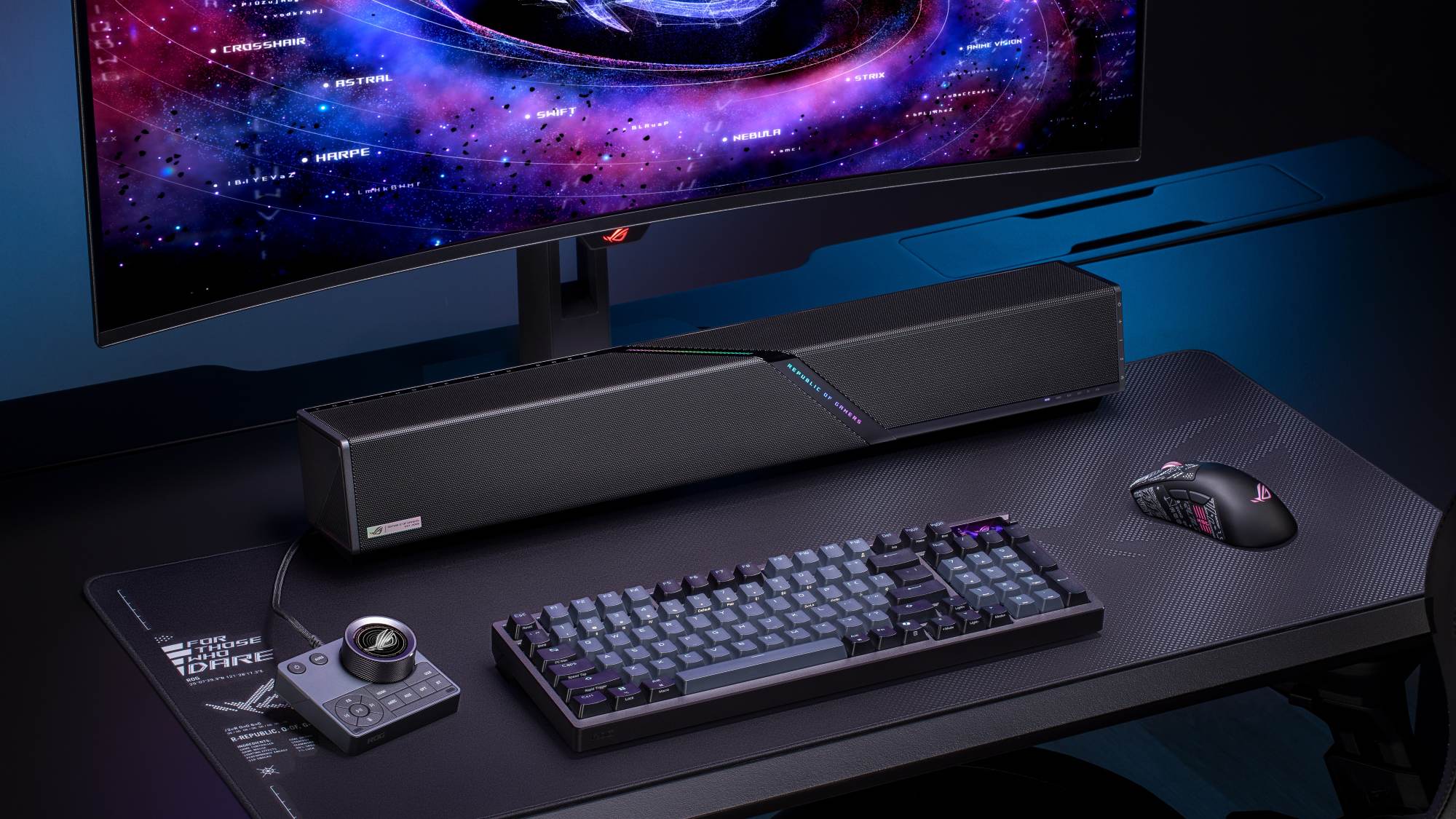
A headset is something you put on, then take off — use, then store. By design, a soundbar is a bigger piece of equipment that’s meant to stay put beneath your monitor or TV, always ready to sound off. There's no battery to charge before a session or rushed fumbling to put it on when the squad starts PvP matchmaking without your approval. It just sits there, waiting for action.
That "always on” stationary nature lets a good gaming soundbar do a job a headset typically can't: act as the central audio hub for your entire desk. Take the Gjallar, for example: its integrated USB hub lets you plug other devices directly into the soundbar itself. Its all-in-one control panel lets you swap inputs, adjust volume, switch EQ profiles, and tweak RGB lighting without opening a single menu, and it connects to nearly everything you own through USB-C, HDMI 2.1 with eARC, optical audio, a 3.5mm jack, and Bluetooth 5.3. In this way, the soundbar can cement itself as a vital piece of battlestation infrastructure, giving you a unified audio solution for all your PC, laptop, console, and other gadgets.
The variety of gaming headsets is staggering

Though a great soundbar covers a lot of ground as a one-size-fits-all solution, different gamers have different needs, and the specificity of a bespoke headset can make a huge difference.
If sonic accuracy is your top priority, the ROG Kithara's open-back design and planar magnetic drivers deliver reference-level detail for single-player epics and competitive shooters. If you want one audio device for every gaming situation, the ROG Delta II offers tri-mode wireless connectivity to satisfy PC, console, handheld, and mobile gaming needs. The Delta II also delivers up to 110 hours of battery life, and its DualFlow Audio lets you take in two devices’ audio streams at once. And if you're chasing comfort and value above all else, the accessible, ergonomic ROG Pelta weighs in at just 309 grams while still delivering up to 70 hours of battery life.
Choosing a headset means you can match your audio gear to your exact use case, whether you want tournament-grade positional cues, all-day comfort, or anything in between.
The deal with gaming soundbar and headset microphones
Voice comms are where the gaming headset versus gaming soundbar debate gets a little tricky. Proper gaming headsets always pack microphones, but not all gaming soundbars do the same. You’ll need to pay attention to this when considering your options. But when gaming soundbars do include mics, then there’s a comparison to be had — like in the case of the ROG Gjallar Gaming Soundbar and our wide variety of ROG gaming headsets.
The Gjallar’s built-in microphones use Acoustic Echo Cancellation (AEC) and an AI beamforming algorithm to suppress ambient noise and optimize directional voice capture. AEC is specifically tuned to cancel out the soundbar's own audio bleeding back into the mic, not just general room noise, so the mics can do their job even when your game is blasting.

A headset's boom mic sidesteps audio pickup challenges entirely by sitting an inch or two from your mouth. Many of our headsets’ mics, like the ROG Kithara's detachable full-band MEMS boom mic, isolate your voice at the source. This helps the headset mic work exceptionally well in noisy rooms or when you're streaming and want the cleanest outgoing audio.
If the top priority is the most reliable mic capture no matter the environment, an ROG headset’s mic typically has the edge. On the other hand, if the priority is jumping into voice chat with zero setup and nothing on your head, the Gjallar's mic array makes life easy.
Gaming soundbar vs gaming headsets: which is right for you?

Both gaming soundbars and gaming headsets can be excellent investments. It all depends on what you're looking for in your audio experience. A soundbar like the ROG Gjallar offers room-filling immersion and effortless multi-device convenience that’s perfect for gaming battlestations. A gaming headset gives you personal, precise sound tailored to how and where you play, with options like the Kithara, Delta II, and Pelta covering immersion, versatility, and value.
You may ultimately want both types of gear: a gaming soundbar for at-home play when you’re free to dominate your space with noise, and a headset for every other situation. But even if you decide to choose between one or the other — a ROG gaming soundbar or headset — you'll still get what matters most: audio built to pull you deeper into every game.
FAQ
Does a soundbar or a headset give you better positional audio for competitive play?
For raw precision, a headset has the edge. It puts sound right against your ears with no room acoustics to interfere. A soundbar's spatial audio (like the Gjallar's Dolby Atmos support) fills the room beautifully, but a headset keeps footsteps and directional cues locked in regardless of your room's shape or size.
Does the ROG Gjallar have a microphone?
Yes. Its built-in mic array uses Acoustic Echo Cancellation (AEC) and an AI beamforming algorithm, so it suppresses ambient noise and cancels the soundbar's own audio bleeding back into the mic while still capturing your voice clearly.
Which has the more reliable mic for streaming or voice chat: a soundbar or a headset?
A headset's boom mic sits an inch or two from your mouth, which typically gives it the edge for consistent capture in any environment.
What are the advantages of wireless headsets over wired headsets?
Freedom from a cable is the big one. You can lean back, get up, or move around without resistance. Wireless models like the ROG Delta II and ROG Pelta also tend to pack in extras suited to that cord-free use, like lengthy battery lives and tri-mode connectivity across PC, console, and mobile. As such, a good wireless headset can easily follow you between devices, even when you grab your cell or handheld and hit the road.
Do wireless ROG headsets need to be charged before every session?
No. The battery life on modern ROG headsets is generous enough that charging isn't a constant chore. The ROG Delta II runs up to 110 hours per charge, and the ROG Pelta runs up to 70 hours, so most players are topping off occasionally rather than daily.
How does the Gjallar's subwoofer connect to the soundbar?
The subwoofer connects wirelessly over a low-latency 5GHz link with no cable running across the floor. It's a 6.5-inch, 65-watt subwoofer built to add real physical punch to explosions and engine rumble without a wired hookup.
Can the ROG Delta II handle audio from two devices at once?
Yes. Its DualFlow Audio feature lets you take in two devices' audio streams simultaneously. So, for example, you can have a Discord squad call on your phone while game audio pours in from your ROG XBOX Ally handheld.
Author
Popular Post
How to clean your OLED monitor
How to adjust your laptop's P-Cores and E-Cores for better performance and battery life
How to configure your PC's RGB lighting with Aura Sync

HOW TO REPLACE THE SWITCHES IN YOUR ROG GLADIUS III GAMING MOUSE
Best ROG gaming laptops by budget: entry, mid-range & flagship picks
LATEST ARTICLES
Best ROG gaming laptops by budget: entry, mid-range & flagship picks
With so many ROG gaming laptop choices, it's easy to find a machine that fits your budget and best serves the way you play.
How to unlock the maximum TGP of your ROG gaming laptop in Armoury Crate's Manual Mode
If you want to push your laptop GPU's Total Graphics Power (TGP) and CPU wattage to its maximum, Manual Mode in Armoury Crate will get you there.
How to configure your ROG XBOX Ally X20's OLED display for the best HDR picture quality
Wondering how to set up HDR on your ROG Xbox Ally X20? Here's how to get the best picture from its OLED display, plus Auto HDR and OLED Care tips.